To a 150.0 mL 3-neck flask was added IrCl3·3H2O (1.0
g, 3.0 mmol) followed by addition of 95% of ethanol (17.0 mL), water (8.5 mL)
and 1,5-cyclooctadiene (3.0 mL, 24.5 mmol) under nitrogen atmosphere. The resulting
mixture was stirred under reflux for 24 h and formed a brick red precipitate.
It was allowed to cool to room temperature and filtered. The precipitate was
rinsed with cold methanol to remove the trace amount of 1,5-cyclooctadiene
unreacted. Then the product was dried in vacuum for 8 h. And [Ir(COD)Cl]2
was obtained in 67% yield as a brick red solid. mp 200–202 °C.
Adsense
Raji Chem World Search Engine
Custom Search
Find the Properties of Chemicals
Nature Chemistry
Nature Chemistry
Adsense
Nature Chemistry
Showing posts with label Catalyst Prepration. Show all posts
Saturday, June 20, 2015
Friday, March 1, 2013
Preparation of bis(acetonitrile)dichloropalladium(II) (CH3CN)2PdCl2
A suspension of PdCl2 (1.00 g, 5.65 mmol) was heated to reflux in CH3CN (50 ml) with vigorous
stirring for 10 h under N2. Hot filtration of the resultant wine-red coloured solution through a ceolite pad into stirred petroleum spirit (40–60 oC) at room temperature afforded a yellow-orange solid. Recrystallisation from CH3CN (100 ml), DCM (150 ml) and hexane (50 ml) gave (CH3CN)2PdCl2 as a bright yellow powdery solid.
Reference: Mathews, Christopher J.; Smith, Paul J.; Welton,Tom J. Mol. Catal. A Chem., 2003, 206, 77.
Preparation of bis(acetonitrile) palladium (II) p-toluenesulfonate (Pd(CH3CN)2(OTs)2:
To a clear dark orange solution of Pd(OAc)2 (0.33 g, 1.47 mmol) in acetonitrile (30 ml) a solution of
p-toluenesulfonic acid (1.5 g, 7.9 mmol) in acetonitrile (40 ml) was added dropwise with stirring.
The color gradually changed to pale yellow. Subsequently diethyl ether (50 ml) was added, and this
resulted in precipitation of fine pale yellow microcrystals. The suspension was set aside over night
and the supematent liquid was decanted. The crystals were washed with diethyl ether, dried under a
slight vacuum, and shown to be Pd(MeCN)2(OTs)2.
Reference: E. Drent; J. A. M. van Broekhoven; M. J. Doyle J. Organomet. Chem., 1991, 417, 235.
Preparation of palladium (II) trifluoroacetate [Pd(TFA)2]
A 50 ml oven-dried flask was charged with Pd(OAc)2 (1.0 g, 4.46 mmol). 25 ml trifluoroacetatic acid
was added. The mixture was stirred and heated to reflux (at 90 °C) in an oil bath. A gray-brown solid
was formed as the mixture was heated. The solid was isolated by filtration and washed with
trifluoroacetic acid (ca. 10 ml). The residue was dried under vacuum at 40°C for 3 h offering a
brownish powder.
Reference: Daniel P. Bancroft; F. Albert Cotton; Mark Verbruggen Acta Cryst. 1989, C45, 1289.
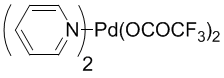
Preparation of [Pd(Py)2].(TFA)2
Pd(OAc)2 253mg (1.127mmol) was dissolved in anh. benzene 17mL (10 min stirring with gentle heating) and pyridine 0.180mL (2.226mmol) was added dropwise over 5 min. The mixture color turned light and a precipitate formed. The closed flask was wrapped in aluminum foil and the mixture was stirred overnight (12 hours). The obtained slurry was evaporated to dryness, the flask with the solid residue was flushed with oxygen and neat trifluoroacetic acid 2.1mL (protein-sequencing grade) was added. The obtained yellow solution was diluted with methanol 20mL and the mixture was stirred under cotton-filled drying tube while wrapped in Al foil for 2 hours. The resulting slurry was filtered through a small medium-porosity frit, the precipitate on the frit was dissolved by gradual washing with 1:1 mixture methanol-dichloromethane (10mL). The combined filtrates were slowly evaporated and the residue was dried on highvac. Y=554mg (100%) of a yellow-white heavy powder.
1H(CDCl3, 400MHz): 8.512(m, 4H), 7.855(app tt, 7.7Hz, 1.5Hz, 2H), 7.405(m, 4H); 13C(CDCl3, 100MHz): 163.09(q, 37.2Hz, 2C), 151.11(4C), 139.83(2C), 125.70(4C), 114.09(q, 289Hz, 2C)
Subscribe to:
Posts (Atom)